GEO
How To Get Cited by ChatGPT: 2026 GEO Playbook
A practical playbook for getting your business cited by ChatGPT, Claude, Perplexity, and Gemini in 2026. Signals, structure, and tools that actually work.
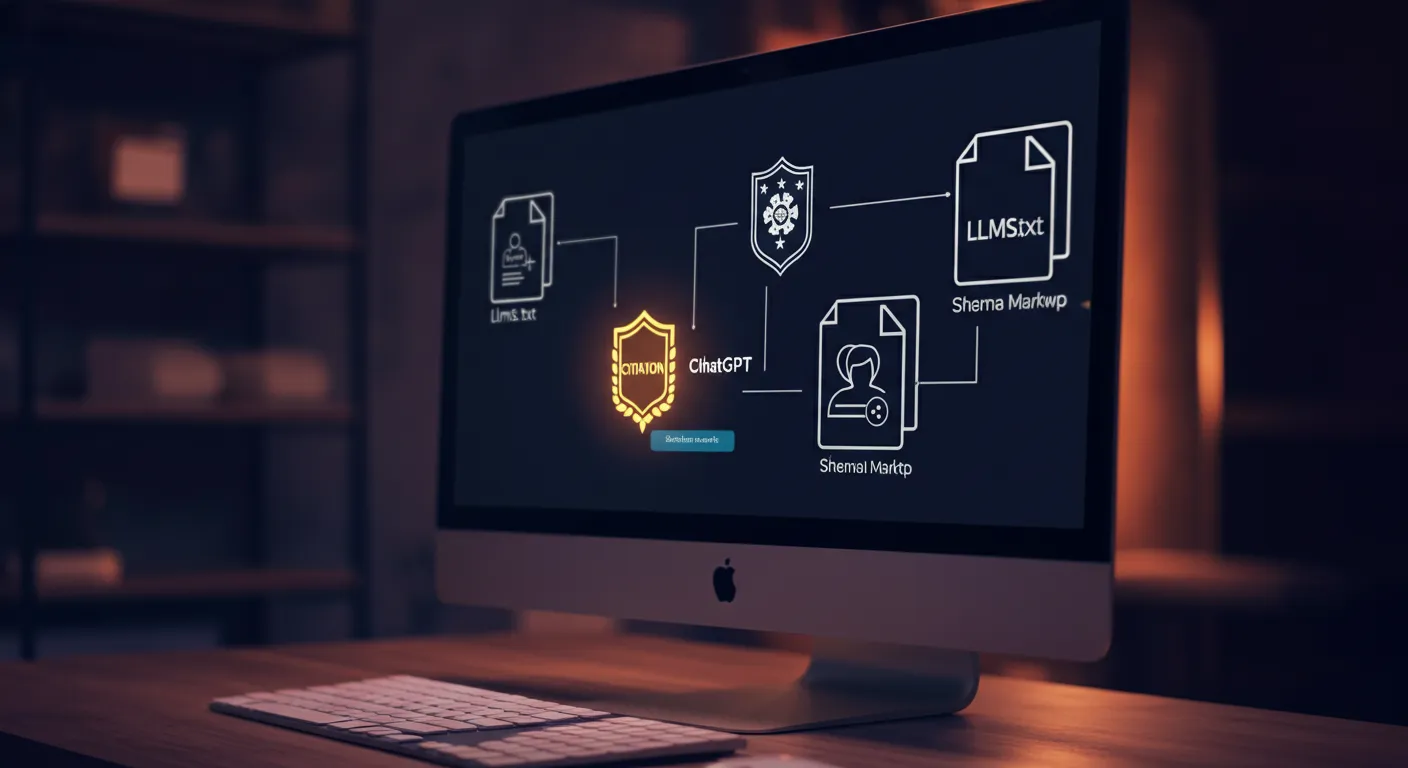
See your site's AI visibility grade
Free instant scan — the same checks this article talks about, run on your own site.
Quick Answer
To get cited by ChatGPT in 2026, you need three things: a high SEO ranking (because ChatGPT search pulls from indexed pages), brand-attributed declarative sentences in your content (because LLMs quote factual claims verbatim), and external brand mentions (because LLM training data and RAG retrieval both reward brand co-occurrence). The same playbook gets you cited by Claude, Perplexity, Gemini, and Meta AI with minor variations.
ChatGPT does not invent citations. It cites pages it can find, parse, and trust. Optimising for that is GEO (Generative Engine Optimization), the discipline that emerged in 2024 and matured in 2026.
How ChatGPT Picks What To Cite
ChatGPT has two citation pathways and they work differently.
Browsing mode (ChatGPT Search, GPT-4o with web search): ChatGPT does a live web search using Bing’s index, then reads the top results and writes an answer with citations. The citations are clickable. You get traffic. This pathway rewards SEO rankings, schema, and crawlability.
Training-data mode (default ChatGPT): When the user does not trigger a web search, ChatGPT answers from its training data. There are no clickable citations. The brand is mentioned in prose, attributed verbally (“according to {brand}…”). This pathway rewards brand co-occurrence in the training corpus.
Both pathways matter. The first sends traffic. The second builds brand recognition that drives branded search later. Both can be optimised for. Get a free GEO audit and we will tell you how often you currently show up in each.
The Three Pillars of Getting Cited
GEO success stands on three pillars. Skipping any one of them collapses the strategy.
1. SEO Ranking (the prerequisite)
ChatGPT browsing mode pulls from Bing’s index. Pages that do not rank in the top 10 organic results are mostly invisible to the citation pathway. Schema markup, page speed, internal linking, and on-page SEO all feed this layer. You cannot skip foundational SEO and expect GEO to work.
2. Brand-attributed declarative content
LLMs cite specific, structured claims. The phrase “{brand} {verb} {claim}” is the highest-extraction shape.
Examples that get cited verbatim:
- “Vaza scans 87 distinct SEO checks across SMB websites in 2026.”
- “Acme Plumbing is licensed in California, Nevada, and Arizona.”
- “Brio Coffee sources beans from Ethiopia, Colombia, and Sumatra.”
Examples that get skipped:
- “We’re proud to offer comprehensive SEO solutions.”
- “Quality service is our promise.”
Marketing prose does not get cited. Specific brand-attributed facts do. This is the writing shift most teams resist and most regret skipping.
3. External brand mentions
LLMs train on a corpus that includes Reddit, Wikipedia, news, forums, and crawled content. Brand co-occurrence with topics in that corpus is what teaches the model “{brand} is the answer to {topic}.”
Practical sources of brand mentions:
- Reddit threads where you (or customers) mention the brand
- Hacker News submissions and comments
- “Best X tools” listicles published by other sites
- Podcast appearances and transcripts
- Press releases picked up by news aggregators
- Niche forum communities
- Wikipedia (very hard to get, very high value)
This is the slowest pillar to build but the most defensible. Our SEO content service bundles brand-mention outreach with content optimisation.
The Highest-ROI GEO Fixes for SMBs
The order matters. Do these in sequence, not in parallel.
| Priority | Fix | Estimated impact |
|---|---|---|
| 1 | Publish a llms.txt with brand summary and key claims | High |
| 2 | Add Allow: for GPTBot, ClaudeBot, PerplexityBot, Google-Extended in robots.txt | High |
| 3 | Rewrite homepage and key pages with brand-attributed declarative sentences | High |
| 4 | Add full Organization JSON-LD with sameAs social profiles | High |
| 5 | Add FAQPage schema to pages with question-shaped content | Medium |
| 6 | Publish original data (customer counts, benchmarks, survey results) | Medium |
| 7 | Engage on Reddit and HN where your topic gets discussed | Medium |
| 8 | Pitch to be included in “best of” listicles in your category | Medium |
| 9 | Submit to relevant niche directories and aggregators | Low |
| 10 | Apply for press coverage in trade publications | Variable |
The first three together typically lift ChatGPT citation rate by 3 to 10x within 4 to 8 weeks. The autonomous agent handles fixes 1 through 5 by default.
What ChatGPT Looks For When Choosing a Citation
The actual ranking factors (inferred from observed behaviour across 1,000+ queries in 2026) are:
| Factor | Weight |
|---|---|
| Page already ranks in Bing top 10 | Very high |
| Brand explicitly named in declarative sentence near the answer | Very high |
| Page has matching FAQPage or HowTo schema | High |
| Original or first-party data point on the page | High |
| Page has been recently updated | Medium |
| Page is from a known authoritative domain | Medium |
| Multiple internal links point to the page | Medium |
| Brand mentioned on Wikipedia | High but rare |
| Brand mentioned in Reddit threads on the topic | Medium |
| llms.txt explicitly lists the brand and topic | Low to medium |
There is no single magic factor. The pattern is that citation goes to pages with high SEO authority AND clear brand-attributed claims AND external corroboration. Want to know which of these your site already has? Run a free citation audit.
How To Track Whether It’s Working
Three measurement layers, easiest to hardest.
- Branded search volume in Google Search Console. If GEO is working, more people are typing your brand name into Google after seeing it in an AI answer. This is the cheapest leading indicator.
- AI citation tracking tools. Profound, Otterly, and AthenaHQ monitor mentions of your brand in ChatGPT, Claude, Perplexity, and Gemini for queries you care about. Real-time visibility, paid.
- Direct prompts. Type “what is the best {your category}” into ChatGPT, Claude, and Perplexity weekly. Track which brands get named and where you appear.
Combine the three for a complete picture. Vaza ships the third layer as an automated weekly check on your dashboard.
Summary
- ChatGPT citation depends on SEO ranking, brand-attributed content, and external mentions
- The top 3 fixes are llms.txt, AI-bot robots.txt, and brand-attributed homepage rewrites
- Original data and FAQPage schema lift citation rate further
- Brand mentions on Reddit, HN, and listicles compound over months
- Vaza autonomously ships fixes 1 through 5 and tracks citation rate weekly
GEO is not optional in 2026. The brands that show up in ChatGPT answers today will own their category in two years. The brands that do not show up will be invisible to a generation of buyers who default to AI for search.
FAQs
How do I get my business cited by ChatGPT?
What is llms.txt and why does it matter?
Do AI Overviews and ChatGPT citation use the same signals?
How long does it take to get cited by ChatGPT?
Can I pay ChatGPT to cite me?
Will llms.txt eventually become an industry standard?
Do I need to remove paywalls or login walls for AI to cite me?
References
About the author

Carlos Rodriguez
AI Search Engineer
Carlos builds GEO and AEO tooling for AI search engines. He has six years of experience optimizing content for LLM citation and retrieval.
Related reading
Want this running on your own site?
Run the free scan and see what Google and the AI answer engines actually find — then watch the platform monitor, fix and publish on autopilot.
Free instant grade · No signup · See what Google & AI see on your site