SEO
SEO vs AEO vs GEO in 2026: Complete Comparison for SMBs
SEO, AEO, and GEO target different search surfaces with different signals. Clear definitions, comparison table, and 2026 strategy for SMBs.
See your site's AI visibility grade
A free instant scan: the same checks this article talks about, run on your own site.
Quick Answer
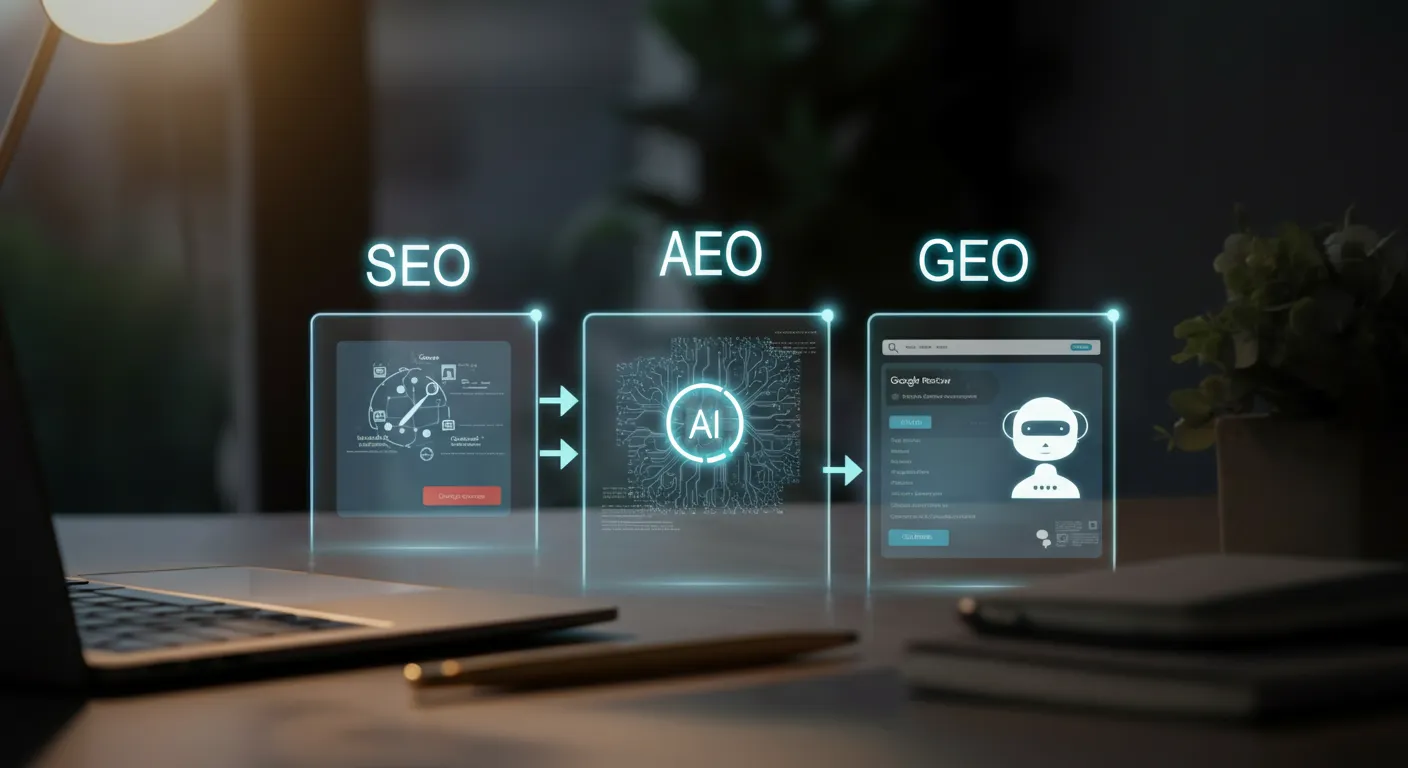
SEO targets the blue-link results page on Google and Bing. AEO targets the AI Overview shown above those results and the answers voice assistants read aloud. GEO targets the answers ChatGPT, Claude, Perplexity, and Gemini give directly without sending the user to your site. Same content, three different surfaces, three different optimization stacks. In 2026, SMBs that win all three see compounding lead growth.
What Each Acronym Actually Means
The category names are new, the underlying optimisation is partly old.
SEO (Search Engine Optimization) is the practice of structuring a website so it ranks high on Google, Bing, and other traditional search engines. The output is a clickable result. The metric is traffic. This has been the SEO industry since the late 1990s.
AEO (Answer Engine Optimization) is the practice of being cited inside Google AI Overviews, Bing Copilot, voice assistants (Siri, Alexa+, Google Assistant), and featured snippets. The output is your content being read aloud or summarised. The metric is citation share. The discipline emerged in 2023 with featured snippets and matured in 2025 with AI Overviews.
GEO (Generative Engine Optimization) is the practice of being mentioned by standalone AI chatbots (ChatGPT, Claude, Perplexity, Gemini, Meta AI) when they answer user questions. The output is your brand appearing in an LLM response, sometimes with a clickable citation, often without. The metric is brand mention frequency. The discipline emerged in 2024 and exploded in 2026 as standalone chatbot usage scaled.
If your existing site is set up for SEO only, you are visible to roughly half the 2026 search universe. Want to see which AI engines currently cite your business? Get a free citation audit and we will check your visibility across ChatGPT, Claude, Perplexity, and Gemini.
The Comparison Table
The fastest way to internalise the difference is to look at the surfaces side by side.
| Dimension | SEO | AEO | GEO |
|---|---|---|---|
| Surface | Google/Bing blue links | AI Overviews, voice assistants, featured snippets | ChatGPT, Claude, Perplexity, Gemini, Meta AI |
| User sees | Clickable result, you get traffic | AI-generated answer that quotes you | LLM response that mentions you |
| User clicks through? | Yes, ~10% of searches | Rarely, ~8% when AI Overview is shown | Almost never, <1% referral rate |
| Success metric | Organic traffic | Citation in AI Overview | Brand mention frequency in LLM responses |
| Key signal | Backlinks, authority, on-page SEO | Featured snippet ownership + schema | Brand co-occurrence + original data + RAG retrievability |
| Primary schema | Article, BreadcrumbList, Organization | FAQPage, HowTo, Speakable | All AEO schemas + llms.txt + entity-dense brand mentions |
| When it emerged | 1998 | 2023 (snippets), 2025 (AI Overviews) | 2024 (ChatGPT browsing) |
| Volume in 2026 | ~50% of search queries | ~58% of Google queries trigger AI Overview | ~900M weekly ChatGPT users globally |
The three are layered, not competing. The same fast, well-structured page can win all three if the optimisation work is done properly. Our SEO content service is built around this layered model.
Where the Optimisation Work Overlaps
About 70% of the work is shared across all three.
- Page speed and Core Web Vitals. All three surfaces preference fast pages.
- Clean HTML and semantic structure. Crawlers, AI Overviews, and LLMs all read your DOM.
- Schema markup. Article, Organization, FAQPage, BreadcrumbList feed every surface.
- Strong topical authority. Backlinks, internal linking, mentions all build entity recognition.
- First-paragraph definition (answer-first). The first 50 words after the H1 get extracted by all three surfaces.
- Question-form H2 headings. Voice queries, AI Overview prompts, and AI chatbot responses all match against question shape.
This is why a single autonomous agent can target all three at once. Run a free scan and we will show you which shared signals are already in place and which are missing on your site.
Where the Work Diverges
The other 30% is surface-specific.
| Surface | Surface-specific work |
|---|---|
| SEO | Backlinks, internal linking, programmatic SEO, comparison content, keyword research |
| AEO | Speakable schema, featured-snippet capture, voice-query keyword research, Google Business Profile, local pack |
| GEO | llms.txt, brand mentions on Reddit/HN, original data publishing, RAG-friendly content chunking, entity-dense intros |
A pure SEO agency in 2026 covers about 30 to 50% of what you actually need. A modern agent covers all three layers from one stack.
The 2026 Playbook for SMBs
Here is the practical order of operations to win all three.
- Fix SEO foundations. Title tags, meta descriptions, heading hierarchy, internal linking, sitemap, robots.txt, canonicals. These have to work before anything else compounds.
- Ship complete schema stack. Article, BreadcrumbList, Organization, FAQPage, HowTo, Product, LocalBusiness, Speakable. Each schema activates a different AI surface.
- Rewrite intros for answer-first structure. The first sentence under every H1 and H2 should open with a declarative answer (“X is…”). This is how AI Overviews and voice assistants extract content.
- Publish llms.txt with your core claims. Make it easy for AI crawlers to ingest your unique brand attribution.
- Convert H2s to question form where they match user queries. Voice queries are 7 to 10 words and shaped as questions.
- Publish original data. Customer counts, benchmarks, survey results. LLMs cite proprietary numbers with brand attribution.
- Get brand mentions outside your site. Reddit, HN, listicles, podcasts. These feed RAG and training data for GEO.
- Monitor citation share, not just traffic. Use AI citation trackers to see whether ChatGPT, Claude, Perplexity, and Gemini mention you for your target queries.
Summary
- SEO, AEO, and GEO target three different surfaces with three different metrics
- They share about 70% of the optimisation work (schema, speed, structure)
- The other 30% is surface-specific (backlinks for SEO, Speakable for AEO, llms.txt for GEO)
- In 2026, winning all three compounds because AI Overviews and chatbots pull from top-ranked SEO results
- SMBs should fix foundations first, then layer AEO and GEO on top
The smartest 2026 SEO investment is an integrated agent that covers all three layers from one stack. Vaza was built specifically for SMBs that need full-coverage AI search optimisation without managing three vendors.
FAQs
Is GEO replacing SEO?
What is the difference between AEO and GEO?
Which one should an SMB start with in 2026?
Do AI Overviews kill all SEO traffic?
How do I track whether ChatGPT cites my business?
Does schema markup help with GEO and AEO too?
Will GEO and AEO matter in 5 years?
References
About the author

Priya Nair
Search Strategy Lead
Priya advises SMBs on the shift from traditional SEO to AI search. She has ten years of experience across enterprise SEO and AI search optimization.
Related reading
Want this running on your own site?
Run the free scan and see what Google and the AI answer engines actually find. Then watch the platform monitor, fix and publish on autopilot.
Free instant grade · No signup · See what Google & AI see on your site