AI & Automation
AI Chatbots for Small Business Websites: Lead Capture, Automation & Setup Guide
Add an AI chatbot for small business website lead capture in 2026. Step-by-step setup, HubSpot/Calendly integration, and real ROI data inside.
See your site's AI visibility grade
A free instant scan: the same checks this article talks about, run on your own site.
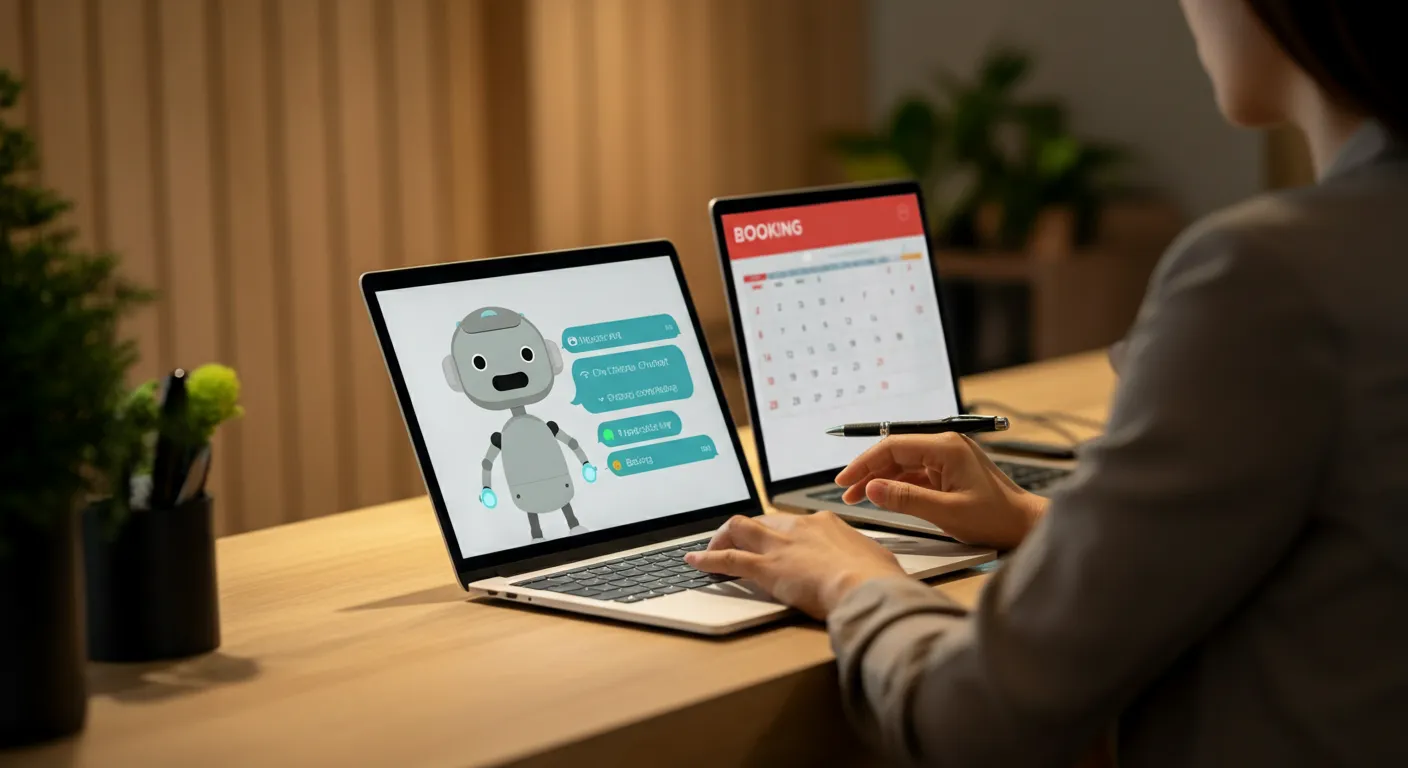
The short answer: An AI chatbot for your small business website can capture and qualify leads 24 hours a day, respond instantly (within seconds rather than hours), and connect interested visitors directly to your calendar, all at roughly $0.50 per conversation. Platforms like HubSpot Chatflows, Tidio, and Landbot make deployment possible in a single afternoon. The data shows chatbots convert at 15 to 25 percent of visitors versus 3 to 5 percent for static forms.
If a potential customer visits your website at 10 PM on a Tuesday, fills out a contact form, and hears back from you the next morning, there is a good chance they have already booked with a competitor. Leads contacted within 5 minutes of inquiry are 21 times more likely to convert than those reached after 30 minutes. For a service business handling dozens or hundreds of monthly inquiries, that gap in response speed is the difference between a full calendar and a slow month. Adding an AI chatbot for your small business website closes that gap permanently.
This guide walks through how to add a chatbot to your website, which platform to choose, how to design conversations that qualify visitors (not just collect their email), and how to connect everything to your CRM and booking tool for a fully automated lead pipeline.
Why Website Chatbot Lead Generation Outperforms Static Forms
Static contact forms have a fundamental problem: they ask for personal information before delivering any value. Visitors fill one out and wait, with no confirmation of what happens next or how long it will take. That friction kills conversion.
AI chatbots work differently. They start a conversation, ask questions that feel like genuine intake (not interrogation), and build enough engagement that visitors willingly share contact details. The result is measurable:
- Chatbot conversion rate: 15 to 25 percent of engaged visitors
- Static form conversion rate: 3 to 5 percent of page visitors
- AI-powered resolution rate: 70 to 85 percent of inquiries handled without human involvement
- Rule-based chatbot resolution rate: 40 to 55 percent (significantly lower)
- Cost per automated conversation: $0.50 versus $6.00 for human support
For a small business handling 500 monthly inquiries, shifting even 60 percent of those to automated chat can generate net annual savings in the range of $225,000 to $231,000 when factoring in reduced staff time and increased lead capture.
The other factor is availability. Most service business websites get substantial traffic outside business hours, exactly when no one is available to answer a phone or monitor a form. A chatbot converts that traffic into booked appointments while your team sleeps.
How to Add a Chatbot to Your Website: Platform Selection
Choosing the right platform before you build anything saves significant rework later. The major options in 2026 break down by use case:
| Platform | Best For | CRM Integration | Starting Price |
|---|---|---|---|
| HubSpot Chatflows | HubSpot-based businesses | Native | Free tier available |
| Tidio | E-commerce and retail service | Shopify, Klaviyo, HubSpot | $29/month |
| Landbot | Visual flows, WhatsApp outreach | HubSpot, Zapier | $45/month |
| Botpress | Custom technical deployments | API-based | Free open-source tier |
| ChatBot | Rapid template deployment | HubSpot, Zapier, Freshdesk | $52/month |
| Aimdoc | HubSpot + Calendly automation | Native HubSpot + Calendly | Custom pricing |
If you are already using HubSpot, start with Chatflows. It creates contacts, logs conversation history, and as of 2026 supports real-time calendar availability checks inside the chat window, without any third-party connector.
If you need WhatsApp or multi-channel reach, Landbot handles cross-channel context preservation, meaning a visitor who starts a conversation on your website can continue it on WhatsApp without repeating themselves.
If you want the fastest setup possible, ChatBot’s template library covers most service business scenarios (appointment booking, quote requests, FAQ deflection) and can be embedded on any website with a single script tag.
For most small service businesses (contractors, medical practices, legal firms, salons), HubSpot Chatflows or ChatBot will cover 90 percent of use cases at a cost that makes sense.
AI Customer Service Chatbot Setup: Step-by-Step
Here is the sequence that produces qualified leads rather than just conversations.
Step 1: Define Your Chatbot’s Single Job
Most chatbots underperform because they try to do everything: answer FAQs, capture leads, book appointments, and handle complaints in one flow. Pick one primary goal per chatbot instance:
- Lead capture bot: Collects name, service interest, timeline, and contact info
- Booking bot: Checks calendar availability and confirms appointments
- FAQ deflection bot: Answers common questions and escalates complex ones
Deploy different bot instances on different pages. Your pricing page gets the booking bot. Your homepage gets the lead capture bot.
Step 2: Design the Qualification Sequence First
The most important 2026 best practice shift is this: ask qualification questions before you ask for contact information. The old approach (ask for email first) triggers resistance. The new approach uses reciprocity: once a visitor has answered three or four questions about their situation, they are psychologically invested and far more likely to complete the contact step.
A strong qualification sequence for a home services business looks like this:
- “What type of project are you looking to get started on?” (service selection)
- “Roughly when are you hoping to start?” (timeline)
- “Is this for a home or commercial property?” (qualifier)
- “What area are you located in?” (location/serviceability)
- “Great. What is the best number or email to send your quote to?” (contact capture)
Four questions, one contact request, answered naturally. This follows a conversational version of the BANT framework (Budget, Authority, Need, Timeline) without sounding like a sales script.
If your platform supports data enrichment (domain lookup or LinkedIn matching), use it. Every question you can skip by pre-filling data from a known email domain improves completion rates by 5 to 10 percent per question removed.
Step 3: Configure Behavior-Triggered Deployment
Do not set your chatbot to pop up immediately on every page. Blanket popups increase bounce rates and irritate visitors who are just browsing. Instead, set triggers based on intent signals:
- High-intent pages: Show chatbot after 30 seconds on pricing, services, or contact pages
- Exit intent: Trigger when a cursor moves toward the browser bar on a quote or booking page
- Scroll depth: Activate after a visitor scrolls 60 to 70 percent of a services page
- Return visits: Greet returning visitors differently from first-time ones
Step 4: Connect to HubSpot and Calendly
This is where the lead pipeline becomes truly automated. The goal is zero manual data entry between a chatbot conversation and a booked appointment in your calendar.
HubSpot connection steps:
- In HubSpot, go to Conversations, then Chatflows
- Create a new bot flow and set contact creation to trigger automatically when a visitor submits their name and email
- Enable conversation logging so every chat transcript is attached to the contact record
- Set a workflow to notify your sales rep by email or Slack when a qualified lead is created
Calendly connection steps:
- In Calendly, generate a scheduling link for the relevant meeting type (discovery call, estimate appointment)
- In your chatbot flow, embed the Calendly widget or link as the final step after contact capture
- If you use Aimdoc or a similar integration layer, it handles the full handoff: chatbot qualifies, Calendly checks availability, HubSpot logs the booking, all inside one conversation thread
With this setup, a visitor who starts chatting at 11 PM can be a confirmed appointment on your calendar by 11:05 PM, with a contact record in HubSpot and a calendar invite already in their inbox.
Step 5: Build a Human Escalation Path
Hybrid AI plus human approaches achieve 90 to 95 percent resolution rates. Pure bot-only flows hit a ceiling. Build a clear escalation trigger:
- If the visitor asks a question the bot cannot classify, offer a live chat handoff or schedule a callback
- If a visitor types “speak to someone” or “call me,” route immediately to a human queue
- Set business-hours logic so the escalation option connects to a live agent during staffed hours and to a callback scheduler outside them
Maintaining that human path is not a sign of chatbot failure. It is what separates a functional lead pipeline from one that frustrates buyers who are ready to purchase.
Measuring AI Chatbot ROI for Small Business Websites
Do not measure chatbot success by conversation volume. Measure it by outcomes. Track these four numbers from day one:
1. Conversation-to-lead rate: The percentage of chatbot conversations that produce a named contact with a phone number or email. Target 15 to 25 percent. Below 10 percent means your qualification sequence needs revision.
2. Cost per conversation: Divide your monthly platform cost by total conversation volume. At scale, this should approach the $0.50 per conversation benchmark. If you are over $2.00, you are either on the wrong plan or generating too few conversations to justify the fixed cost.
3. Lead response time: The time between a visitor submitting contact info and your team following up. With a fully automated HubSpot plus Calendly flow, this should be near zero for self-scheduled appointments. For leads routed to a rep, target under 5 minutes during business hours.
4. Booked appointments per month attributed to chat: Pull this from HubSpot by filtering contacts created via chatbot and then tracking downstream pipeline activity. Compare against your pre-chatbot baseline.
Run this measurement window for 60 to 90 days before drawing conclusions. Most businesses see meaningful conversion improvement in the first 30 days, but the qualification sequence typically needs one to two rounds of refinement based on real conversation data.
For service businesses that want to combine chatbot lead capture with a fast-loading, technically sound website, it is worth reading how modern website architecture affects conversion performance and how local SEO strategies compound the traffic that feeds your chatbot pipeline.
If you are also evaluating the broader AI toolset for your marketing stack, the AI SEO tools comparison for small business covers how chatbot automation fits alongside content and search tools.
For a free SEO and conversion audit of your current website, the vaza.ai team reviews your existing traffic, form conversion rate, and site speed, all of which directly affect how much value a chatbot can add.
Key Takeaways
- AI chatbots convert 15 to 25 percent of engaged visitors, compared to 3 to 5 percent for static contact forms
- The 2026 best practice is to ask 4 to 6 qualification questions before requesting contact information, not after
- Chatbot conversations cost roughly $0.50 each versus $6.00 for human support interactions
- Behavior-triggered deployment (not blanket popups) is essential for avoiding bounce rate increases
- HubSpot Chatflows plus Calendly creates a fully automated pipeline from conversation to confirmed appointment
- Hybrid AI plus human escalation paths achieve 90 to 95 percent resolution rates; pure bot-only flows plateau lower
- Leads followed up within 5 minutes are 21 times more likely to convert than those contacted after 30 minutes
- Measure success by conversation-to-lead rate, cost per conversation, response time, and booked appointments, not raw chat volume
- Poor implementation (aggressive popups, bot-only dead ends) actively decreases conversions, so setup quality matters as much as platform choice
References
- Chatbot on Website Statistics 2026: Usage, Conversions, and ROI - Scalify
- AI Chatbot for Lead Generation: How to Get Qualified Leads Fast in 2026 - Bluehost Blog
- How to Integrate an AI Chatbot with HubSpot (2026 Guide) - Aimdoc
- AI Chatbot Lead Generation: Real Case Studies and ROI Data for 2026 - Fastbots
Key takeaways
- AI chatbots convert 15 to 25 percent of engaged visitors, compared to 3 to 5 percent for static contact forms
- The 2026 best practice is to ask 4 to 6 qualification questions before requesting contact information, not after
- Chatbot conversations cost roughly $0.50 each versus $6.00 for human support interactions
- Behavior-triggered deployment (not blanket popups) is essential for avoiding bounce rate increases
- HubSpot Chatflows plus Calendly creates a fully automated pipeline from conversation to confirmed appointment
Frequently Asked Questions
How much does an AI chatbot for a small business website cost?
Entry-level plans on platforms like Tidio or ChatBot start at $29 to $49 per month. Mid-tier plans with CRM integration and multi-channel support run $99 to $299 per month. Automated chatbot conversations cost roughly $0.50 each, compared to $6.00 for a human support interaction, so most SMBs recoup the subscription cost quickly.
How long does it take to set up a chatbot on a small business website?
A basic lead-capture chatbot can be live in one to two hours using a template-based platform like ChatBot or Tidio. A fully qualified workflow with HubSpot CRM sync, Calendly booking, and custom conversation branches typically takes three to five business days to configure and test properly.
Do AI chatbots actually generate more leads than web forms?
Yes. Chatbots convert at 15 to 25 percent of visitors, compared to 3 to 5 percent for static web forms. The difference comes from conversational engagement: chatbots ask questions progressively, build rapport, and request contact information only after the visitor has already invested in the conversation.
What is the best AI chatbot platform for small businesses in 2026?
It depends on your stack. Tidio suits e-commerce stores, Landbot excels at WhatsApp and visual flows, Botpress fits technically advanced teams, ChatBot is ideal for rapid template-based deployment, and HubSpot Chatflows is best if you are already in the HubSpot ecosystem. Most SMBs start with HubSpot Chatflows or Tidio.
Can a chatbot replace my sales team?
No. The highest-performing implementations use chatbots to qualify leads at scale, then route warm prospects to a sales rep within minutes. Chatbots handle the top-of-funnel screening using frameworks like BANT, but human judgment closes deals. Think of the chatbot as a 24/7 intake specialist, not a closer.
How do I connect a chatbot to HubSpot and Calendly?
In HubSpot, use the Chatflows builder under Conversations to create a bot that creates contacts and logs conversations natively. For Calendly, embed a scheduling step in your conversation flow using Calendly's widget or connect via a third-party integration tool like Aimdoc or Zapier. HubSpot's native calendar integration as of 2026 also supports real-time availability checks inside the chat window.
What response time do AI chatbots achieve compared to human agents?
AI chatbots respond instantly, 24 hours a day. This matters because leads contacted within 5 minutes of inquiry are 21 times more likely to convert than leads contacted after 30 minutes. Human agents rarely match that speed outside business hours, which is where most website inquiries actually arrive.
How do I avoid annoying visitors with a chatbot popup?
Use behavior-triggered messaging instead of blanket popups. Set the chatbot to appear only on high-intent pages (pricing, contact, service pages) and only after 30 to 60 seconds of scroll activity or when a visitor shows exit intent. Blanket popups on every page load are the leading cause of chatbot-driven bounce rate increases.
What is website chatbot lead generation best practice in 2026?
The critical 2026 shift is asking qualification questions before requesting contact data, not after. Ask 4 to 6 naturally phrased questions first (budget, timeline, service need), then request an email or phone number. This sequence uses psychological reciprocity: the visitor has already invested in the conversation and is far more likely to complete contact capture.
How do I measure chatbot ROI for my small business?
Track four metrics: conversation-to-lead rate (target 15 to 25 percent), cost per conversation ($0.50 automated vs. $6.00 human), lead response time (goal: under 5 minutes), and booked appointments per month attributable to chat. Compare these against your previous form or phone-only baseline over a 60 to 90 day window.
Related reading

Want this running on your own site?
Run the free scan and see what Google and the AI answer engines actually find. Then watch the platform monitor, fix and publish on autopilot.
Free instant grade · No signup · See what Google & AI see on your site