
SEO Strategy
Why Your Website Traffic Dropped: AI Search Engines & GEO in 2026
AI Overviews cut organic CTR by 61%. Learn how GEO recovers visibility across ChatGPT, Perplexity, and Google AI search.
See your site's AI visibility grade
A free instant scan: the same checks this article talks about, run on your own site.
The short answer: When AI Overview queries appear in Google, organic click-through rates drop by 61%. Globally, 68% of Google searches now end without any external click. If your site is not being cited inside AI answers on Google, ChatGPT, or Perplexity, you are losing visibility that traditional rankings alone cannot restore. Generative engine optimization (GEO) is the discipline that fixes this.
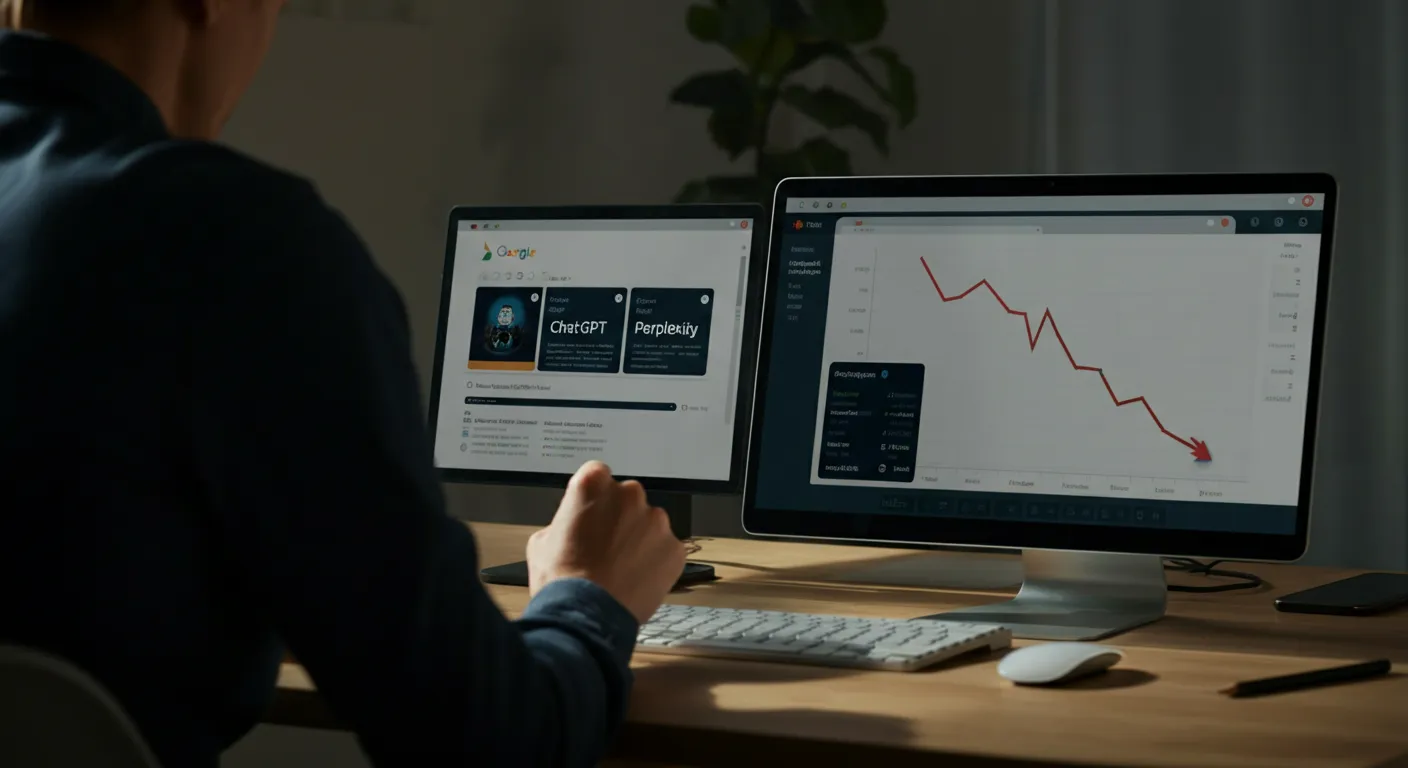
You logged into Google Analytics, and the numbers were bad. Not down a few percentage points. Down noticeably, across the board, with no clear penalty, no manual action, and no technical error you could point to. If you have been asking yourself why your website traffic dropped after AI search went mainstream, the answer is structural, not accidental. The way people find information has changed faster than most SEO playbooks have adapted, and this article gives you the specific data and steps to respond.
Why AI Search Is Causing Website Traffic to Drop in 2026
The shift is not one single cause. It is three separate forces arriving at the same time.
Force 1: Zero-click search has crossed a threshold. As of 2026, 68% of Google searches end without an external click. On queries where AI Overviews appear, that number rises to 83%. On mobile, globally, 77% of searches produce no click at all. Your site could rank in position 3 and receive a fraction of the traffic that position earned in 2023.
Force 2: AI Overviews are appearing far more often. Google AI Overviews now appear on 25 to 48% of searches, up from 13% in early 2025. Every time one appears on a query your page ranked for, the CTR for every organic result underneath it drops by 61%.
Force 3: Research behavior has moved into AI chat tools. By mid-2026, 35 to 50% of U.S. B2B buyer research starts inside a large language model (ChatGPT, Perplexity, Claude) rather than in a traditional search bar. These tools do not consistently route users through your ranked pages at all.
Gartner forecast a 25% decline in traditional search engine volume by 2026, and early data confirms that trajectory. U.S. organic search traffic dropped 2.5% year over year in early 2026, with content publishers hit hardest at a 38% referral traffic decline.
The Citation Overlap Collapse: What’s Causing My Website Traffic to Drop
Here is the data point that surprises most business owners: as of April 2026, only 38% of AI Overview citations come from Google’s top 10 results. Seven months earlier, that figure was 76%.
A separate analysis confirms that the overlap between AI-cited sources and traditional top-ranking pages has fallen from roughly 70% in early 2024 to under 20% in 2026. That means 80% of the pages AI systems choose to cite rank outside page one.
This is the core reason why asking “why did my website traffic drop after AI search” is the wrong first question. The better question is: is my site even being cited inside the AI answers my potential customers are reading?
If you are not cited, you do not benefit from the one upside in this environment. Brands that are cited inside AI Overviews earn 35% more clicks than they would from a comparable standard organic listing. Perplexity citations convert at 11 times the rate of traditional organic search. The traffic is still there. It has just moved to a different selection process.
| Platform | Monthly Query Volume | AI Referral Traffic Share | Citation Conversion Advantage |
|---|---|---|---|
| Google AI Overviews | Billions (25-48% of searches) | Majority of AI-driven clicks | 35% more clicks for cited brands |
| ChatGPT | 2 billion daily queries | 87.4% of AI chatbot referrals | Lower direct click volume |
| Perplexity | 1.2-1.5 billion/month | 15-20% of AI referral volume | 11x traditional organic conversion rate |
What Is Generative Engine Optimization (GEO) and How It Differs from Traditional SEO
Generative engine optimization (GEO) in 2026 is the practice of structuring content, authority signals, and technical markup so that AI answer systems select your pages as cited sources, not just as ranked results.
Traditional SEO optimizes for ranking positions. GEO optimizes for citation selection. The two overlap significantly but are not identical, and that gap is where most businesses are losing ground right now.
What AI Systems Look For When Selecting Citations
AI systems do not simply pull from whichever page ranks highest. They select sources based on:
- Specificity and structure. Pages with clearly stated facts, statistics, and data points are easier for AI to extract and attribute.
- Schema markup. Sites with comprehensive schema markup appear in 47% more Perplexity responses than sites without it.
- E-E-A-T signals. Author credentials, named experts, external mentions, and citations from third parties signal that content is trustworthy.
- Content that resists summarization. AI systems tend to cite original research, proprietary data, and firsthand expert accounts because these cannot be replicated without attribution.
- Breadth of platform presence. Being mentioned across multiple sources (industry publications, forums, review platforms) increases the probability that AI systems treat your brand as authoritative.
For a practical guide on getting your business cited by ChatGPT, Claude, and Perplexity specifically, see How to Get Your Small Business Cited by ChatGPT, Claude & Perplexity AI.
AI Search Traffic Loss Recovery: Actionable Steps for 2026
Recovering from AI search traffic loss is not a one-step fix. It requires changes to your content structure, technical setup, and measurement approach.
Step 1: Audit Which Queries Are Being Cannibalized by AI Overviews
Open Google Search Console and filter by queries where your impressions are high but CTR is unusually low. These are strong candidates for AI Overview cannibalization. Prioritize the informational queries first because they suffer the most.
Then check those same queries in Google to see whether an AI Overview appears. If it does, your page is competing in a zero-click environment. Your two choices are: get cited inside that AI Overview, or shift your content angle toward transactional and commercial intent where AI is less likely to answer fully.
Step 2: Implement Schema Markup Across Core Pages
Schema markup has moved from a ranking bonus to a citation necessity. The 47% improvement in Perplexity citation rates for schema-enabled sites is not a small margin. Prioritize:
- Article schema with named authors and publish dates
- FAQ schema on pages that answer direct questions
- Organization schema on your homepage
- LocalBusiness schema if you serve a geographic market
If your site runs on a modern static or headless architecture, schema implementation is far cleaner than managing it through WordPress plugins. See Astro Framework for SEO: Static + Hybrid Rendering for Fast Local Rankings for how modern frameworks handle this at the structural level.
Step 3: Produce Content AI Cannot Fully Summarize
This is the most durable generative engine optimization strategy for 2026. Original content types that consistently earn citations include:
- Original survey data or proprietary benchmark reports
- Named expert interviews with attributed quotes
- Interactive calculators or tools that require visiting your site to use
- First-person case studies with specific numbers and timelines
- Local data that AI systems cannot generate (your city’s specific permit costs, regional pricing comparisons, etc.)
For service businesses, this means publishing specific project examples, real pricing ranges for your market, and patient or client outcome summaries (appropriately anonymized) rather than generic informational content that an AI can rewrite without needing you.
Step 4: Build E-E-A-T Infrastructure
Google’s own Search Quality Evaluator Guidelines and the signals feeding AI Overview selection both weight Experience, Expertise, Authoritativeness, and Trustworthiness heavily. Concrete actions:
- Add real author bios with credentials to every piece of content
- Earn mentions in industry publications or local news
- Actively manage your Google Business Profile reviews as trust infrastructure
- Get listed in industry-specific directories relevant to your vertical
Step 5: Monitor AI Visibility Directly
Traditional rank tracking does not measure AI citation frequency. Use tools that track brand mention rates across AI platforms, or run manual spot checks weekly by querying your target questions in ChatGPT, Perplexity, and Google with AI Overviews enabled. Track whether your brand is cited, paraphrased without citation, or absent entirely.
Pair this with Best AI SEO Tools for E-Commerce in 2026 for a breakdown of which tool categories are now covering AI visibility tracking.
Traditional SEO and GEO Must Run Together
A common mistake in 2026 is treating GEO as a replacement for traditional SEO. It is not. The 31% of AI citations that come from positions 11 to 100 and the additional 31% from beyond position 100 show that traditional ranking still influences AI citation selection. A page with no authority signals rarely gets cited regardless of its structure.
The right model is: maintain and improve your technical SEO foundation while layering GEO-specific signals on top. For small businesses with limited content budgets, this means:
- Keep your core service pages optimized for traditional ranking
- Add structured, citable content (statistics, FAQs, expert commentary) to those same pages
- Build schema markup site-wide
- Focus new content creation on formats that earn citations rather than formats that earn generic ranking
For local service businesses specifically, the intersection of local SEO and GEO is especially important. Local queries still drive transactional intent, and AI systems increasingly pull local business data from structured profiles. See Local SEO for Plumbers, Contractors & Home Service Businesses: City-by-City Strategies for how to maintain local visibility in the AI era.
If you want a professional assessment of where your site stands across both traditional ranking and AI citation signals, get a free SEO audit from vaza.ai and we will identify which of your pages are being displaced by AI Overviews and which have citation potential.
Summary: What to Do If Your Traffic Dropped After AI Search Took Hold
- Understand the cause. AI Overviews now appear on up to 48% of searches, dropping organic CTR by 61%. Zero-click searches hit 68% on Google and 83% on AI Overview queries.
- Recognize the citation gap. Only 38% of AI-cited sources rank in Google’s top 10. You can earn citations from positions outside page one if your content is structured correctly.
- Implement schema markup immediately. Sites with comprehensive schema appear in 47% more Perplexity responses. This is the single highest-impact technical step.
- Create content AI must cite rather than summarize. Original data, expert interviews, local specifics, and interactive tools drive citation selection.
- Build E-E-A-T signals. Named authors, third-party mentions, and credentialed expertise all influence both AI citation selection and traditional ranking quality.
- Do not abandon traditional SEO. GEO and classic ranking work together. Dropping one weakens the other.
- Measure AI visibility directly. Rank tracking alone does not show whether you are present in AI answers. Add manual checks and AI-specific monitoring to your reporting.
References
- Google AI Overviews CTR Impact and 2026 Adaptation Strategies - Dataslayer
- Google AI Overview Citations From Top-10 Pages Dropped From 76% to 38% - ALM Corp
- Mastering Generative Engine Optimization in 2026: Full Guide - Search Engine Land
- 46 AI Search Statistics 2026: ChatGPT, Perplexity, and AI Overviews - Sunny Patel
Frequently Asked Questions
Why did my website traffic drop after AI search engines became popular?
AI search tools like Google AI Overviews, ChatGPT, and Perplexity answer questions directly without sending users to your site. When an AI Overview appears in Google, organic click-through rates drop by 61% on average. If your site is not being cited as a source inside those AI answers, you are invisible in the new search environment.
What is generative engine optimization (GEO) and why does it matter in 2026?
Generative engine optimization (GEO) is the practice of structuring your content, data, and authority signals so that AI answer engines select your site as a cited source. By mid-2026, 35 to 50 percent of U.S. B2B buyer research starts inside an LLM rather than a traditional search engine, making GEO a required discipline alongside classic SEO.
How much has AI reduced organic search click-through rates?
When Google AI Overviews appear, organic CTR drops 61% compared to standard results. Globally, 60% of searches are now zero-click, and on mobile that figure rises to 77%. However, brands cited inside AI answers earn 35% more clicks than they would from an average organic position.
Does appearing in AI Overview citations still drive website traffic?
Yes. Even though overall CTR is lower, brands cited inside AI Overviews earn 35% more clicks than comparable organic listings. Perplexity citations convert at 11 times the rate of traditional organic search. The goal is citation placement, not just ranking.
How do I get my business cited by ChatGPT or Perplexity?
Structure your content around specific facts, original data, and expert quotes. Implement schema markup (sites with schema appear in 47% more Perplexity responses). Build E-E-A-T signals through author credentials, industry mentions, and third-party citations. Publish content that AI systems cannot simply summarize away, such as original research or proprietary data.
What types of searches are most affected by AI traffic loss?
Informational queries suffer the most because AI engines answer them directly. Transactional and navigational queries are less affected because users still need to visit a site to make a purchase, book an appointment, or find a physical location. Prioritizing content tied to commercial intent helps offset informational traffic loss.
How quickly can GEO improvements show measurable results?
Most sites that implement structured GEO practices, including schema markup, E-E-A-T content improvements, and citation-optimized formatting, see measurable visibility improvements within 60 to 90 days. Some studies show GEO techniques yielding 30 to 40 percent visibility gains in AI responses within that window.
What percentage of AI Overview citations actually rank in Google's top 10?
As of early 2026, only 38% of AI Overview citations rank in Google's top 10, down from 76% just seven months earlier. This means 62% of cited sources rank outside page one, proving that traditional ranking alone no longer determines AI citation selection.
Should I stop doing traditional SEO and focus only on GEO?
No. Traditional SEO and GEO should run in parallel. Classic ranking signals still influence which pages AI systems trust, and transactional queries still drive direct clicks. The businesses gaining the most ground in 2026 are those maintaining their technical SEO foundation while adding GEO-specific content structure on top.
What is causing my website traffic to drop as more people use AI?
Three forces are converging: AI answer engines satisfy queries without a click, zero-click search rates have risen to 68% on Google overall and 83% on AI Overview queries, and Google referral traffic has declined significantly year over year. Your traffic is not simply lower because your rankings dropped; it is lower because fewer searchers click any result at all.
Related reading



Want this running on your own site?
Run the free scan and see what Google and the AI answer engines actually find. Then watch the platform monitor, fix and publish on autopilot.
Free instant grade · No signup · See what Google & AI see on your site